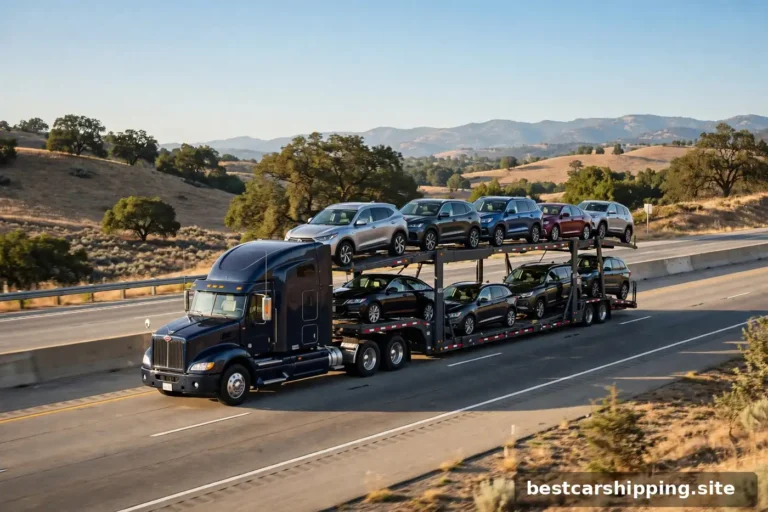
Shipping a Car to Another State: Step-by-Step
Shipping a car to another state takes 7–14 days from booking to delivery for most routes: 1–5 days for carrier pickup, plus transit time by distance. Expect $400–$1,700 for open transport depending on mileage. The process is straightforward — quotes, booking, prep, pickup inspection, transit, delivery inspection — and this guide walks through every step.
Every year, hundreds of thousands of cars move between states — relocations, out-of-state purchases, college moves, snowbird migrations, military PCS orders. The process is the same whether you’re moving from Texas to Florida or buying a car in California while living in New York. Six steps, each with its own decisions and pitfalls. Here’s the complete walkthrough.

The process at a glance
| Step | What happens | Your time | Typical timing |
|---|---|---|---|
| 1. Quotes | Collect and compare 3–5 quotes | 1–2 hours | 2+ weeks before move |
| 2. Booking | Choose a company, sign contract, pay deposit | 30 minutes | 2+ weeks before move |
| 3. Prep | Clean, photograph, remove items, maintenance check | 2–3 hours | Days before pickup |
| 4. Pickup | Inspection, Bill of Lading, handoff | 30–60 minutes | Pickup window (1–5 days) |
| 5. Transit | Carrier hauls your car | None (waiting) | 1–8 days by distance |
| 6. Delivery | Inspection, Bill of Lading, final payment | 30–60 minutes | Delivery window |
Total elapsed time from booking to delivery: typically 7–14 days for most interstate routes. Total cost: $400–$1,700 for open transport of a standard sedan, depending on distance. Now the detail.
Step 1: Get and compare quotes
Start at least two weeks before you need the car moved — more is better. You’ll need: pickup and delivery ZIP codes, vehicle year/make/model, whether it runs, your preferred pickup date range, and your transport preference (open is the default; enclosed costs 30–60% more).
Get 3–5 quotes. Legitimate quotes for the same shipment cluster within a few hundred dollars — the honest price is usually in the middle of the pack. A quote dramatically below the others is the classic bait-and-switch setup: you’ll pay a deposit, then the price “adjusts” upward once you’re committed. Our quote comparison guide covers the ten questions that separate real quotes from marketing, and our scams guide details the red flags.
What you’re really choosing at this stage isn’t just a price — it’s a company. Verify FMCSA authority (MC number on SAFER), read the 1-star reviews for patterns, and confirm the quote includes everything: total price, deposit terms, pickup window, and cancellation policy. Price matters, but a $100 cheaper quote from an unverifiable company is the most expensive option available.
Step 2: Book your shipment
Booking means signing a contract and usually paying a deposit. Before you sign, confirm:
- The total price is firm (or understand exactly what could change it — vehicle misrepresentation is the legitimate trigger; “market changes” is not).
- The deposit terms: how much, when it’s charged, and whether it’s refundable. Modest deposits are normal; many reputable brokers charge nothing until a carrier is assigned. Never pay by wire transfer.
- The pickup window: 1–5 days is standard. A “guaranteed” exact date costs extra — decide if you need it.
- The cancellation policy: what it costs to cancel, and by when.
- Who the carrier will be: brokers should disclose the assigned carrier’s name, MC number, and insurance certificate before pickup. Get this commitment in writing.
After booking, the broker posts your load and matches a carrier. You’ll typically get the carrier assignment a few days before pickup. When you do, verify the carrier’s cargo insurance using our insurance verification checklist — certificate in hand, cargo line confirmed, exclusions understood.
Key takeaways
- Start quotes 2+ weeks out; compare 3–5; trust the middle of the pack.
- Verify FMCSA authority and read 1-star review patterns before booking.
- Get the assigned carrier’s name, MC number, and insurance certificate in writing.
Step 3: Prepare the car
Preparation takes an afternoon and prevents most pickup-day problems:
- Wash the car thoroughly. The pickup inspection can only record visible damage — dirt hides scratches. A clean car means an accurate Bill of Lading.
- Photograph everything. All four sides, 3/4 angles, close-ups of every existing scratch and dent, odometer, VIN plate. Timestamp on, backed up to cloud.
- Remove personal items and valuables. Carrier cargo insurance doesn’t cover contents. Most carriers allow up to ~100 lbs of personal items (some allow none) — check your contract, and keep it to the trunk, below window level.
- Quarter tank of fuel. Enough for loading and unloading, not so much that you’re paying to ship gasoline.
- Check the basics. Tire pressure (including the spare), battery charge, fluid levels, no active leaks. Disable the alarm — a car alarm going off on a trailer at 2 AM makes no friends.
- Remove or secure accessories. Roof racks, bike racks, spoilers, antennas — remove what you can, secure what you can’t.
- Gather documents. Registration, proof of insurance, and photo ID. If someone else is handing over or receiving the car, arrange authorization in writing.
The full checklist with explanations lives in our car prep guide.
Step 4: Pickup day
The driver arrives within your pickup window — you’ll usually get a call a few hours ahead. Be present (or have your authorized person present) with the keys.
The critical event: the pickup inspection and Bill of Lading. Walk the car with the driver, panel by panel, in good light. Every existing scratch, dent, and chip gets marked on the BOL’s vehicle diagram with specific notation — location, type, size. Record the odometer and fuel level. Review the diagram before signing; sign only when it accurately reflects the car. Never sign a blank BOL. Photograph the signed document.
Hand over one set of keys (keep your spare). Confirm the driver’s contact number and the expected transit time. The car is loaded — driven or winched onto the trailer — strapped down, and it’s gone. Our Bill of Lading guide walks through the inspection and notation in detail.
If the driver refuses a proper inspection or pressures you to sign quickly, document it and call your broker immediately. That’s not normal.
Step 5: Transit
Your car is on the truck. What happens now:
- Transit time by distance: roughly 1–2 days per 500 miles, but carriers don’t drive your car straight through — they run multi-stop routes. See the timeline table below.
- Communication: the driver or broker should provide updates and a delivery window as the truck approaches. Save the driver’s number from pickup day.
- Tracking: true GPS tracking is uncommon in auto transport; expect phone/text updates rather than a live map. Anyone promising real-time GPS tracking of your specific car is overselling.
- Delays happen: weather, traffic, mechanical issues, and other customers’ schedule changes all affect multi-stop routes. A day or two of variance around the estimated delivery is normal. A week of silence is not — call your broker.
Your car’s safety during transit rests on two things you already handled: the carrier’s verified cargo insurance and the pickup BOL documenting its condition. There’s nothing to do during transit except stay reachable — the driver needs to reach you to coordinate delivery.

Step 6: Delivery day
The driver calls with a delivery window — often a few hours’ notice. Be present with payment for the balance (usually cash, cashier’s check, or money order to the driver; confirm the accepted method in advance — this is a common surprise).
Then the second critical event: the delivery inspection. Before signing anything:
- Walk the car with the pickup BOL and your pickup photos.
- Compare panel by panel, in good light.
- Notate any new damage on the delivery BOL — location, type, size — and have the driver acknowledge it.
- Photograph any damage extensively before the car is moved.
- Sign the delivery BOL, take your copy, photograph it.
If you find damage: notate it, photograph it, notify the broker and carrier in writing within 24 hours (most contracts require 24–48 hour notification), and file the claim with the carrier’s cargo insurer. The insurance guide covers the claims process; the Bill of Lading guide covers the inspection.
If everything matches, sign the clean BOL, pay the balance, and get your keys. Done.
Key takeaways
- Pickup: inspect with the driver, notate everything on the BOL, never sign blank, photograph the signed document.
- Transit: stay reachable; a day or two of variance is normal, a week of silence isn’t.
- Delivery: inspect before signing, compare against pickup photos, notate new damage immediately.
Costs by distance band
Open transport, standard sedan, door-to-door, normal season — 2026 national averages from CitizenShipper:
| Distance | Example routes | Open | Enclosed |
|---|---|---|---|
| Under 500 mi | Dallas–Houston, LA–Phoenix | $400–$700 | $700–$1,100 |
| 500–1,000 mi | Chicago–Nashville, NYC–Charlotte | $700–$1,000 | $1,100–$1,500 |
| 1,000–1,500 mi | Chicago–Denver, Atlanta–Dallas | $800–$1,200 | $1,300–$1,800 |
| 1,500–2,500 mi | NYC–Denver, Seattle–Dallas | $1,000–$1,500 | $1,600–$2,400 |
| 2,500+ mi | NYC–LA, Miami–Seattle | $1,100–$1,700 | $1,800–$3,000+ |
Adjust for your situation: SUVs/trucks add $100–$450 (size guide); inoperable vehicles add ~$150 (inoperable guide); rural pickup/delivery adds $150–$300; summer peak season runs higher. Every factor is detailed in our master cost guide and the 9 cost drivers breakdown.
Realistic timelines
From booking to delivery, plan on:
| Distance | Pickup window | Transit | Total (booking→delivery) |
|---|---|---|---|
| Under 500 mi | 1–3 days | 1–2 days | 5–9 days |
| 500–1,000 mi | 1–4 days | 2–3 days | 6–11 days |
| 1,000–1,500 mi | 1–5 days | 3–4 days | 7–13 days |
| 1,500–2,500 mi | 1–5 days | 4–6 days | 8–15 days |
| 2,500+ mi | 1–5 days | 5–8 days | 9–17 days |
These assume you booked 2+ weeks ahead. Book last-minute and the pickup window stretches — the carrier has to fit you into an existing route on short notice. Our shipping timeline guide covers what drives delays and how to plan around them.
State-specific considerations
Interstate car shipping is federally regulated, so the process doesn’t fundamentally change by state — but a few state-level wrinkles exist:
- Registration and insurance: you’re not required to re-register or change insurance for the shipment itself, but if you’re relocating permanently, most states require re-registration within 30–90 days of establishing residency. Plan the shipment so the car arrives with time to handle DMV paperwork.
- Emissions and inspections: some states (California most famously) have emissions and safety inspection requirements for newly registered vehicles. A car that passes in Texas might need work to pass in California — worth knowing before you ship, not after.
- Snowbird states: Florida and Arizona see massive seasonal inbound volume in fall and outbound in spring. Shipping on those corridors during migration season costs more and books up faster — plan extra lead time.
- Hawaii and Alaska: not truck-accessible. Hawaii requires ocean freight (roll-on/roll-off or container); Alaska is usually trucked to Seattle then shipped by sea or driven. Different market, different pricing — get specialized quotes.
None of these change the six steps. They just affect timing, cost, and paperwork on the margins.
FAQ
How long does it take to ship a car to another state?
Typically 7–14 days from booking to delivery for most interstate routes: 1–5 days for carrier pickup plus 1–8 days of transit depending on distance. Coast-to-coast moves run 9–17 days total.
How much does it cost to ship a car to another state?
$400–$1,700 for open transport of a standard sedan, depending on distance. Short regional moves (under 500 miles) run $400–$700; cross-country (2,500+ miles) runs $1,100–$1,700. Enclosed adds 30–60%.
What’s the cheapest way to ship a car to another state?
Open transport, terminal-to-terminal, booked 2+ weeks ahead with flexible pickup dates, outside peak season. Our cheapest-way guide has the full playbook.
Do I need to be present at pickup and delivery?
You or an authorized representative must be present — someone has to hand over keys, participate in the inspection, and sign the Bill of Lading. If you can’t be there, arrange it in writing with the broker in advance and brief your stand-in on the inspection process.
Can I put personal items in the car when shipping interstate?
Carrier cargo insurance doesn’t cover contents. Most carriers allow up to ~100 lbs of personal items in the trunk (some allow none) — confirm in your contract and keep valuables out entirely.
How do I track my car during shipping?
Expect phone/text updates from the driver or broker, not a live GPS map — true per-vehicle GPS tracking is uncommon in auto transport. Save the driver’s number at pickup and stay reachable for delivery coordination.
Sources: distance-tier pricing from CitizenShipper’s 2026 cost breakdown; booking and quote practices from Move.org’s cheapest-way guide.