How Much Does It Cost to Ship a Car Cross-Country?
# How Much Does It Cost to Ship a Car Cross-Country?
Shipping a car coast-to-coast (2,500+ miles) in 2026 typically costs $1,100–$1,700 on an open carrier for a standard sedan, or $1,800–$3,000+ enclosed. It’s the most expensive shipment by total — but the cheapest per mile, usually around $0.45–$0.70 per mile.
Key takeaways
- Expect $1,100–$1,700 open or $1,800–$3,000+ enclosed for 2,500+ miles in 2026.
- Per-mile rates bottom out on cross-country runs because fixed costs spread over more miles.
- Route popularity, season, vehicle size, and booking lead time move your quote hundreds of dollars.
- Transit runs 6–9 days after pickup, plus a 1–5 day pickup window — plan around 2 weeks door to door.

Cross-country cost table
These are typical 2026 ranges for a standard, operable sedan shipped door-to-door in a normal season, drawn from current 2026 pricing guides including CitizenShipper’s cost breakdown and Easy Storage Search’s car shipping calculator:
| Distance | Open transport | Enclosed transport | Typical per-mile |
|---|---|---|---|
| 2,000–2,500 miles | $1,000–$1,500 | $1,600–$2,400 | $0.45–$0.80 |
| 2,500+ miles (true coast-to-coast) | $1,100–$1,700 | $1,800–$3,000+ | $0.45–$0.70 |
For context, here’s how the full distance ladder looks — notice how the per-mile column keeps shrinking while the total keeps growing:
| Distance band | Typical open total | Typical per-mile |
|---|---|---|
| Under 500 miles | $400–$700 | $1.00–$2.00 |
| 500–1,000 miles | $700–$1,000 | $0.75–$1.25 |
| 1,000–1,500 miles | $800–$1,200 | $0.60–$1.00 |
| 1,500–2,500 miles | $1,000–$1,500 | $0.45–$0.80 |
| 2,500+ miles | $1,100–$1,700 | $0.45–$0.70 |
The pattern is unmistakable: the longest trips cost the most in total and the least per mile. Our full car shipping cost guide covers every band in more detail.
Why per-mile rates are lowest on long hauls
Every car shipment carries a fixed workload: dispatch, scheduling, driving to your pickup point, the pickup inspection, paperwork, driving to delivery, the delivery inspection. That fixed cost is roughly the same whether the car travels 300 miles or 3,000.
On a short haul, the fixed cost is spread over a few hundred miles — so each mile carries a big chunk of it ($1.00–$2.00 per mile). On a cross-country run, the same fixed cost is spread over 2,500+ miles, so each mile carries a tiny slice ($0.45–$0.70 per mile). The truck also spends most of a long haul doing the efficient part — rolling down the interstate at highway speed — versus the expensive parts: city driving, loading, and waiting.
This is why comparing quotes on per-mile price alone misleads. A fair cross-country quote will always look cheap per mile next to a fair short-haul quote. Compare totals for your route — that’s the number you’ll actually pay.
What moves a cross-country quote up or down
Distance sets the band; these factors set your position in it:
- Vehicle size. A sedan is the base price. SUVs and crossovers typically add $75–$250; large SUVs and minivans $150–$250; full-size pickups $200–$350; heavy-duty or lifted trucks $350–$600. Those surcharge bands come straight from Easy Storage Search’s 2026 vehicle-size table.
- Route popularity. This matters more on long hauls than short ones, because a carrier committing to 2,500 miles needs confidence the lane pays both ways.
- Season. Summer is peak pricing nationwide. Fall brings the snowbird surge on north-to-south routes (think New York to Florida, Chicago to Arizona). Spring is usually the calmest pricing window.
- Operability. A non-running car adds roughly $150 for winching — and on a long haul, some carriers simply won’t take inoperable vehicles, shrinking your options.
- Pickup and delivery locations. Metro-to-metro is cheapest. If either end is rural, expect $150–$300 extra for the deadhead miles off the main freight corridor.
- Booking lead time. Two or more weeks ahead gets more carriers bidding on your job. Last-minute cross-country bookings are where the ugliest prices live.
- Transport type. Enclosed adds 30–60% — on a cross-country run, that’s $700–$1,300+ in real money. Worth it for the right car; painful for the wrong one. See open vs enclosed for the decision framework.
Popular cross-country routes
Not all 2,500-mile trips price the same. Corridors with heavy, balanced freight traffic in both directions get more competing carriers and better prices:
- Los Angeles ↔ Dallas / Texas triangle. Huge volume, frequent service, competitive pricing.
- Miami / Florida ↔ New York / Northeast. The snowbird corridor — cheap in spring when trucks head north empty-ish, expensive in fall when everyone ships south.
- Chicago ↔ West Coast. Steady year-round volume through the middle of the country.
- Seattle / Pacific Northwest ↔ anywhere. Thinner volume at the far end; expect quotes toward the higher side of the band.
A useful rule of thumb: if big metro areas anchor both ends and the route follows a major interstate (I-10, I-40, I-70, I-80, I-95), you’re on a competitive lane. If one end is a small town two hours from the nearest interstate, you’re paying for the detour. And direction matters seasonally — the same lane can price very differently in October versus April, because carrier demand flows with the snowbird migration and the summer moving rush. When you request quotes, asking two or three brokers about directional demand on your specific lane often surfaces savings a form quote won’t show.
Route-pricing data published in 2026 backs this up — for example, California-to-Texas shipments have recently priced in the low $1,200s to mid-$1,800s, while thinner lanes like South Dakota to New York have run higher. The corridor matters as much as the mileage.
How long does cross-country shipping take?
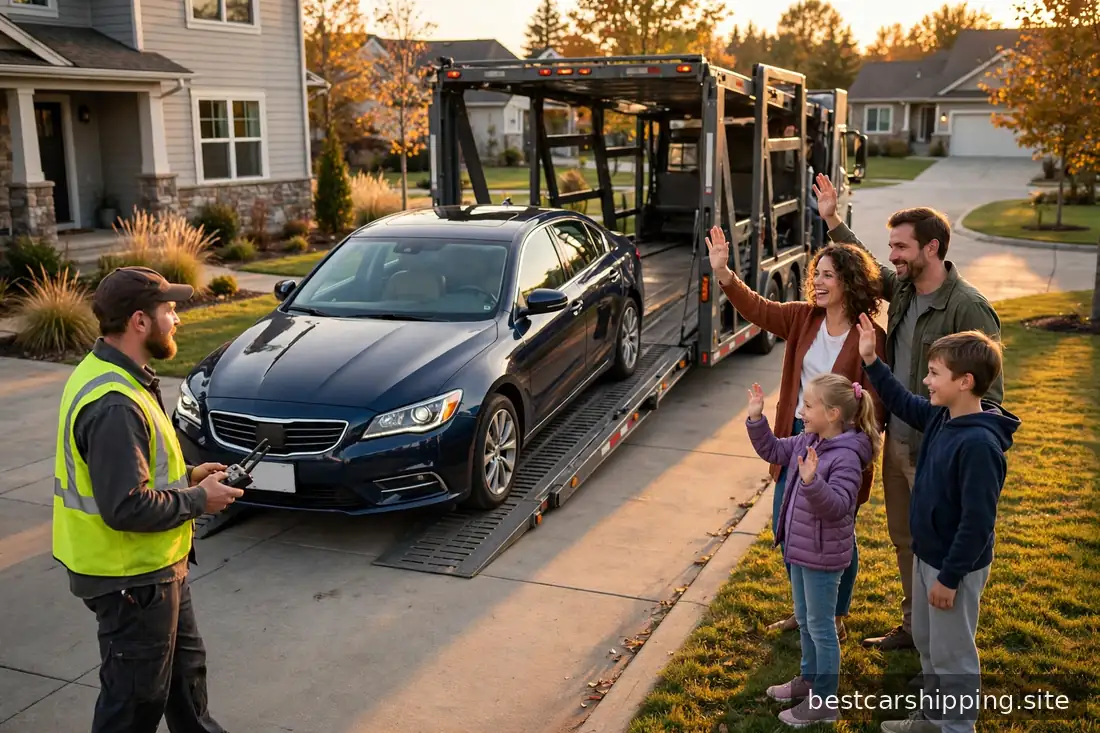
Budget roughly two weeks door to door, broken into two phases:
- Pickup window: 1–5 days. After you book, the broker posts your car and a carrier accepts it. This isn’t a scheduled appointment — it’s a window. Flexibility here is the single biggest lever on both price and speed.
- Transit: 6–9 days. Once loaded, carriers typically cover 350–500 miles per day. A 2,800-mile run at 400 miles a day is 7 days of driving, plus the other cars’ pickup and delivery stops along the way.
Delays happen: weather, mechanical issues, hours-of-service limits, and multi-car route logistics. A good broker communicates; a bad one goes quiet. If you need a firmer date, ask about expedited or guaranteed-pickup options — they cost more, but they exist. Our full car shipping timeline guide breaks down every phase and what causes delays.
Ways to save on a long haul
Cross-country is where smart choices save the most in absolute dollars:
- Ship open. On a long haul, the enclosed premium is $700–$1,300+. Unless the car genuinely needs it, that’s the biggest single saving available.
- Book 2+ weeks out. The bidding effect is strongest on long routes where carriers plan days ahead.
- Be flexible on pickup dates. A 5-day window on a cross-country move can save real money versus demanding Tuesday.
- Meet near the interstate. If you’re rural, driving 30 minutes to a truck-friendly meeting point can erase a $150–$300 rural surcharge.
- Ship in spring or fall. Avoid summer peak and the fall snowbird surge if your schedule allows.
- Consider terminal-to-terminal if terminals exist near both ends — the savings are modest but real, and terminals cluster on major corridors. See door-to-door vs terminal for the trade-offs.
And the standard warning applies double at this distance: a quote far below the $1,100–$1,700 band probably can’t attract a carrier, which means delays or a mid-shipment price hike. Compare 3–5 quotes and treat the outlier with suspicion.
Frequently asked questions
Is it cheaper to ship a car cross-country or drive it?
It’s close. A cross-country drive means 4–5 days on the road: fuel, hotels, meals, and wear can total roughly what an open-carrier shipment costs — plus your time and 2,500+ miles on the odometer. Shipping lets you fly. If you’re moving multiple vehicles or the car is a second vehicle nobody can drive, shipping usually wins clearly.
What’s the cheapest way to ship a car across the country?
Open transport, booked 2+ weeks ahead, with flexible pickup dates, on a popular corridor, in an off-peak season. That combination lands you at the bottom of the $1,100–$1,700 band. Move.org’s cheapest-way guide walks through the same playbook.
Can I ship a car I just bought from another state?
Yes — this is one of the most common cross-country shipments. You’ll need the title or bill of sale and a photo ID at pickup. If there’s a lienholder, check whether they require notification. The dealer or seller just needs to release the car to the driver with the keys.
Do I need to be present at pickup and delivery?
Someone needs to be — you or a designated person — to sign the Bill of Lading and do the inspection walkthrough at both ends. The pickup and delivery contacts can be different people, which helps if you’re flying while the car ships.
What if my dates change after booking?
Tell your broker immediately. Date changes before dispatch are usually free; changes after a carrier is assigned can incur fees or require re-dispatch. This is another reason flexible windows beat fixed dates.
Staying in the loop during a cross-country move
Ask at booking how communication works during transit. Most brokers give you the driver’s direct number once dispatched; the broker remains your point of contact if plans change. Don’t expect minute-by-minute GPS from every carrier — many independents simply call at pickup, mid-route, and before delivery. Agree on check-in expectations upfront, keep your phone on during the delivery window, and make sure your delivery contact knows the plan if it isn’t you.
Cross-country shipping looks intimidating because the numbers are the biggest you’ll see in auto transport — but it’s also the most competitive, most routine segment of the market. Thousands of cars cross the country every week. Price it like a commodity, verify the company, and the process is straightforward.