Shipping an Electric Vehicle: Battery Rules and Costs
Shipping an electric vehicle works like shipping any car — with three wrinkles: the battery makes it heavier, carriers want the charge in a specific range, and handling must protect the battery pack. Expect roughly $200–$500 more than a comparable gas car, a 20–50% charge requirement, and book a carrier that knows EVs.
Key takeaways
- EVs cost roughly $200–$500 more to ship than comparable gas cars, mostly because of battery weight.
- Most carriers require a 20–50% state of charge — enough to load/unload, low enough to limit thermal risk.
- Insist on soft tie-downs and wheel chocks, never chains near the battery pack.
- Disable battery-draining features (Sentry Mode, cabin preconditioning) before pickup.
- Photograph the dashboard charge level at pickup — it’s your proof if disputes arise.
Why EVs Cost More to Ship
The premium is real, and it’s mostly physics. According to a carrier-published 2026 EV shipping guide, expect to pay $200–$500 more than the standard rate for a comparable gasoline vehicle — a figure that lines up with how the industry prices weight.
The weight story in concrete numbers: a Tesla Model 3 Long Range weighs about 4,250 pounds versus roughly 3,500 for a comparable BMW 3 Series — a 750-pound difference that’s essentially all battery. EV battery packs run 800–1,200 pounds, roughly the weight of four to six adult passengers riding along for free.
Why that matters to the carrier: trailers have strict legal weight limits. A trailer that fits eight gas sedans might only legally carry six heavy EVs — and the carrier’s revenue is per-vehicle. Fewer vehicles per load plus worse fuel economy from the extra weight means each EV has to carry more of the trip’s cost. Electric trucks are the extreme case: a Rivian R1T at over 7,000 pounds can cost $300–$500 more to ship than a light electric sedan on the same route.
Three secondary cost factors:
- Specialized handling takes longer. Soft tie-downs, careful positioning to protect the underfloor battery, and EV-specific loading protocols add labor time versus standard chain-and-go loading.
- Insurance costs more. Lithium-ion batteries present fire risks (thermal runaway) that gasoline cars don’t, and carriers’ liability coverage reflects that — a cost passed through in quotes.
- Fewer qualified carriers. Not every carrier is set up or willing to haul EVs, which limits competition on some routes and keeps prices elevated.
None of this is a reason not to ship an EV — it’s just why the quote looks the way it does. Get the exact trim right when quoting: a Long Range or Performance variant with a bigger battery pack weighs more than the base model, and that difference can change the price.
The Battery Charge Rule
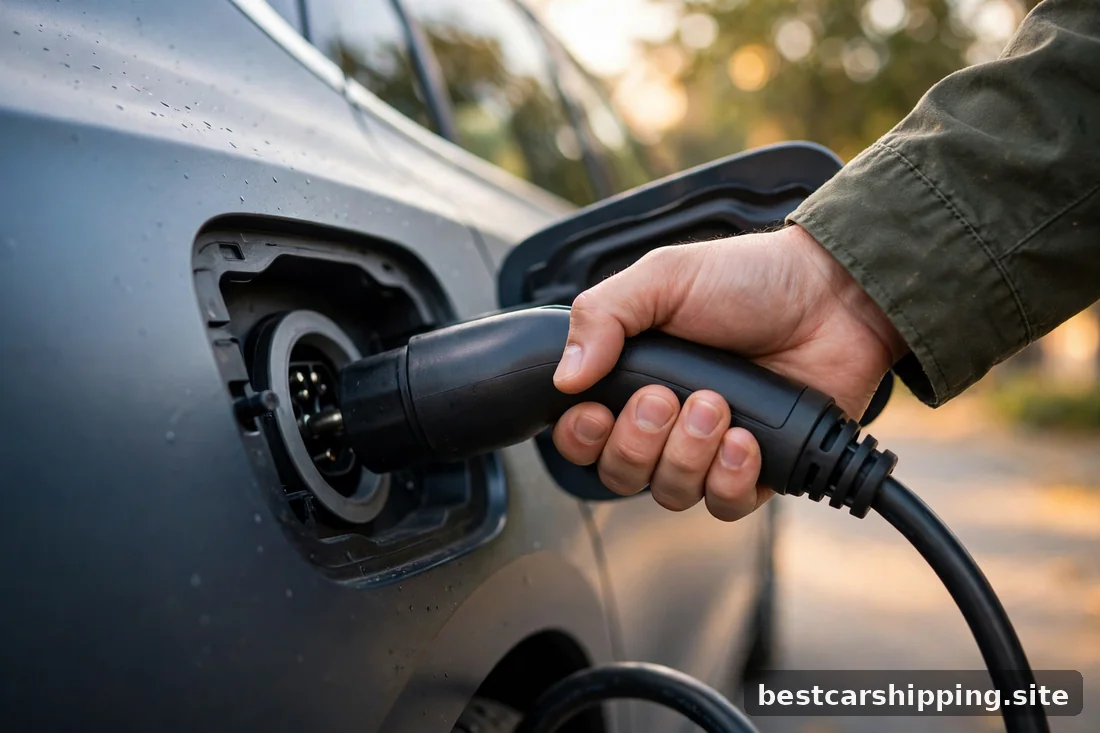
This is the EV-specific requirement that surprises people. Most carriers require EVs to ship with the battery between 20% and 50% state of charge. The logic runs both directions:
- Too high (above ~50–60%): A fully charged battery holds maximum stored energy, which increases the severity risk if the pack is damaged. Some carrier insurance policies exclude coverage or add surcharges for EVs shipped above 50%.
- Too low (below ~10–20%): The carrier needs the car to drive on and off the trailer under its own power — including in cold weather, when battery performance drops. A dead EV on a trailer is a logistical nightmare that causes delays and extra fees.
The sweet spot most guides converge on is 30–40%: comfortably above the dead-battery danger zone, comfortably below the high-energy concern zone. (You’ll see some variation — a few sources suggest up to 50–65% — which is exactly why you should confirm your specific carrier’s requirement when you book rather than treating any single number as gospel.)
Practical steps:
- Charge to the target level the night before pickup — not a week before, since vampire drain (especially with features left on) eats charge while the car sits.
- Photograph the dashboard showing the exact state of charge at pickup. The driver will usually record it too, but your own timestamped photo is your proof.
- If you’re buying out of state and a dealer is handling handover, explicitly ask them to charge the car to the target level — lot cars often sit at 10%.
How Carriers Handle EVs Differently
A carrier that knows EVs does a few things differently from standard practice — and these are worth asking about:
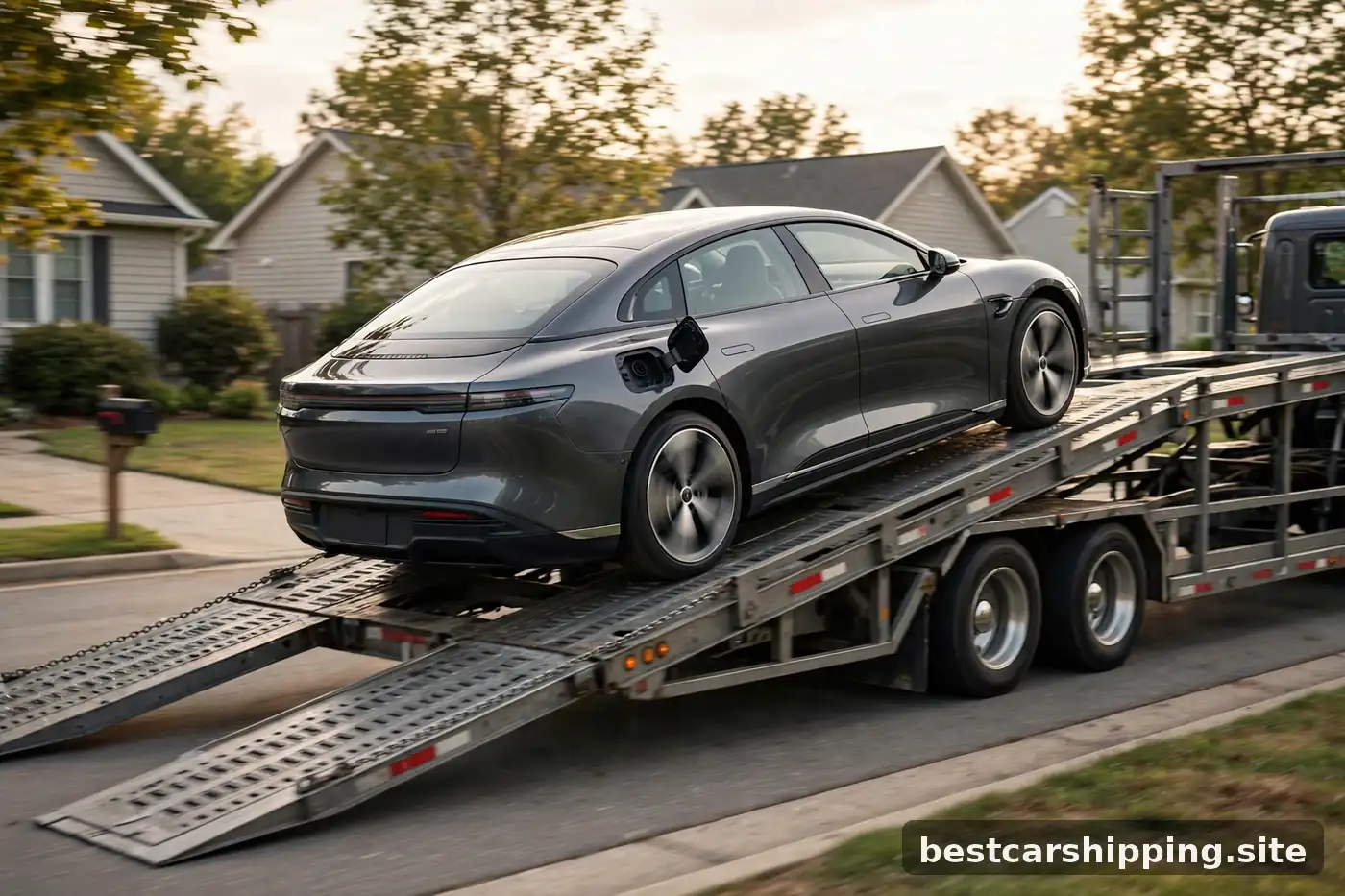
- Soft securing, not chains. Synthetic straps over the tires and precisely positioned wheel chocks, rather than chains over the frame or axles. Chains near an underfloor battery pack are how expensive damage happens.
- Low-angle loading. Many EVs ride low, and the battery sits in the floor pan — vulnerable to scraping on steep ramps. Hydraulic lift gates or low-angle ramps protect both the undercarriage and the pack.
- Weight-aware loading position. Heavier vehicles get positioned on the trailer with weight distribution in mind — this is the carrier’s job, but it’s a sign they know what they’re doing if they mention it.
- No stacking surprises. On multi-level open trailers, drip pans between decks matter more for EVs — fluids from a car above are bad news for anyone, but battery-adjacent electronics make it worse.
Regulatory backdrop, briefly: lithium-ion batteries fall under DOT hazardous-materials classifications (Class 9), which is part of why trained handling and documentation requirements exist around EV transport. You don’t need to know the regulation numbers — you just need a carrier whose drivers have the training.

Preparing Your EV for Shipment
Standard car-shipping prep applies (wash, photos, remove personal items, quarter-tank equivalent), plus EV-specific steps:
- Set the charge to 30–40% and photograph the dashboard.
- Disable battery-draining features: Sentry Mode / dashcam sentry, cabin overheat protection, scheduled preconditioning, and any always-on remote monitoring. These can drain several percent per day — enough to drop a 30% charge into the danger zone on a long transit.
- Turn off alarms — transport vibration triggers them, and a wailing alarm drains the 12V battery.
- Remove charging cables and adapters from the car. They’re theft-prone, not insured, and add nothing to the shipment.
- Leave the mobile key card or fob with the driver (noted on the Bill of Lading) — the carrier needs to move the car at both ends. If your car uses phone-as-key, set up the physical backup.
- Note low-clearance or special features — air suspension settings, jack mode, transport mode if your car has one (Teslas do — it prevents the parking brake from engaging during winching and keeps the car in neutral).
- Check tire pressure and coolant — EVs still have battery coolant that can leak, and proper tire pressure matters for loading.
For the universal prep checklist that applies to every vehicle, see how to prepare your car for shipping. And if your EV doesn’t run at all, the rules change — see shipping an inoperable car.
Open vs Enclosed for an EV
Most EVs ship open, and that’s fine — open transport is how new EVs get from factories to dealerships. The decision framework:
- Open transport is the economical default and perfectly safe for most EVs with proper soft-tie-down handling. Daily-driver Model 3s, Bolts, Leafs, and similar ship open every day.
- Enclosed transport (30–60% more) makes sense for luxury and performance EVs — Lucid Air, high-end Taycans, EQS — where paint and bodywork repair costs dwarf the premium, and for anyone who wants maximum protection from road debris hitting the underfloor battery area.
One EV-specific consideration for open transport: road debris kicked up on the highway can strike the underbody. It’s rare for this to damage a battery pack (they’re armored), but if the thought bothers you on a $100,000 car, that’s what enclosed is for. Our open vs enclosed comparison covers the general trade-offs.
Questions to Ask Before Booking
- “What’s your required battery charge level?” — confirms they have an EV policy at all. Vague answers are a bad sign.
- “Do you use soft straps and wheel chocks for EVs?” — the answer should be yes, with an explanation.
- “How do you handle the extra weight?” — you’re listening for weight-aware loading, not confusion.
- “Is battery damage covered under your cargo insurance, and are there exclusions above a certain charge level?” — get the answer in writing.
- “Can I see your cargo insurance certificate?” — non-negotiable for any carrier, EV or otherwise.
Verify the carrier’s USDOT/MC authority in the FMCSA database yourself — EV or not, that’s the two-minute check that filters out most bad actors.
FAQ
How much more does it cost to ship an electric car?
Roughly $200–$500 more than a comparable gas car on the same route, according to carrier-published 2026 pricing — driven mainly by battery weight (800–1,200 lbs), specialized handling, and higher insurance costs. Heavy electric trucks cost more still.
What battery percentage should my EV be at for shipping?
Most carriers require 20–50% state of charge, with 30–40% the commonly recommended sweet spot. Confirm your carrier’s specific requirement when booking — policies vary. Never ship below 10% or above ~60% without discussing it first.
Can an EV go on a regular open carrier?
Yes — most EVs ship on standard open carriers every day, including new cars going to dealerships. The key requirements are soft tie-downs (not chains), low-angle loading for ground clearance, and a driver who knows EV handling.
Should I disable Sentry Mode before shipping?
Yes. Sentry Mode, cabin preconditioning, and similar always-on features drain the battery during transit — potentially several percent per day. Disable them before pickup so the car arrives with usable charge.
Is enclosed transport worth it for an EV?
For mainstream EVs, open transport with proper handling is fine and far cheaper. For luxury/performance EVs where bodywork costs are extreme, enclosed (30–60% more) buys meaningful extra protection — same logic as any high-value car.